Plan B always turned out better — what I took away from 4 hackathons in 6 months
An hour before the hackathon kicks off, someone tells me I need to get on stage and introduce myself to 150 people. Two years earlier, I was stressed out having a beer at a meetup with a dozen folks. Between those two moments, something happened that I absolutely did not plan. And that's probably exactly why it worked out so well.
Before I ended up at hackathons as a mentor, I was (and still am) working at Tonik — a design, founder first studio. For about 10 months I worked on projects in a startup mode, constantly spinning up new things from scratch, testing, validating, killing or pushing forward. Sounds like a hackathon? Because it basically is one, just commercially. One of the most important things I learned there is that code is secondary. You can have bugs, missing features and a half-working prototype — but if you can present it and collect feedback, you're ahead of someone with perfect code and zero validation. That insight turned out to be the foundation of everything I did at hackathons later on.
Before that, I co-organized meetups and small hackathons in Poznań — casual, intimate events where I was learning to take initiative and talk to people. Think of it as a testing ground for what was coming next.
You don't need to be an expert to help. You just need a bit more experience than the participants.
HackYeah — the last time as a "pure participant"
October 2025, Kraków. The largest on-site hackathon in Europe. I went with a crew from work, we picked a terminal game set in space — saving the world from annihilation. Sounds epic, but in practice it meant pulling an all-nighter, crashing by morning and drinking liters of coffee. And then came the best anecdote: we made it to the finals. Except we found out on the train to Poznań. Too far to go back. Glory was lost somewhere between Katowice and Częstochowa.
But two things stuck with me from that event, and both turned out to be huge later on. First — I experienced firsthand how exhausting hackathon work really is. All-nighters, time pressure, running on fumes. When I later saw tired participants at 6 AM as a mentor, I knew exactly what they were going through. That perspective is priceless.
Second — as a participant, I had virtually no time for networking. I was focused on the task. I only met the HackYeah organizers at the next hackathon — as a mentor, not a participant. That paradox opened my eyes to something I'll get to in a moment.
HackNation — jumping into the deep end
December 2025, Bydgoszcz. 1,500+ participants, organized by the Polish Ministry of Digitalization. Big scale, big stage. Plan A was simple — go as a participant. Problem: the hackathon fell on St. Nicholas Day and I couldn't find a team. So I thought — what if I applied as a mentor? Sent in the form, got approved a few days later. Plan B activated.
I remember the morning of day one. Total stress. I was walking between booths thinking "can I even help anyone here?". And then around 8 AM, the first participants came up with questions. With each conversation, the stress dropped. Turned out I could help. Not because I'm an expert in everything — but because I had a bit more experience than them in a few specific things. I helped build teams (yes, people were looking for teammates just hours before the start!), gave feedback on presentations and advised on strategy. I worked with over 10 teams.
The biggest discovery? I'd never made pitch decks. But over the years at Tonik I'd seen hundreds of them. And that knowledge from just observing turned out to be something participants were missing. You don't need direct experience — careful observation counts too.
I also ran into experienced mentors who showed me something they called walkabout mentoring. You don't sit and wait — you walk between teams, pick one at random, ask "what are you working on?". And often that question alone is enough for people to reframe their own problem in a 5-minute chat. You don't give the answer. You guide. And the best moment is when someone comes back an hour later and says "I came up with a great idea!" — and it's their idea, not yours.
Beyond the mentoring itself, the vibe of the event is a story on its own. Ministers interacting with participants, serious-looking guys observing every move at the expo, and me at one point standing too close to the VIP zone — they told me to step back. Mini heart attack. But I survived. And most importantly: the HackYeah paradox was confirmed. As a mentor, I had way more time to meet people than as a participant. I met the HackYeah organizers right here — at their own event, I never had time for that.
Critical Infrastructure — can I keep up with these people?
January 2026, Gdańsk. 150 participants, entire event in English, topics: Space Tech, Energy & Offshore, Sovereign Communication. A tech park with separate rooms for teams and investment funds walking the halls. And again the same pattern. Plan A: participant. No one from the crew wanted to join. Plan B: mentor. Applied, approved. Surprised, because the event topics were a completely different industry than mine.
The stress here had a different source than at HackNation. There I was thinking "can I do this at all?". Here I was thinking "can I keep up with these people?". Participants showed up with half-finished projects they'd been developing for months. People with serious experience and knowledge that made my skills feel laughably small.
And yet I found my niche. With one team I analyzed infrastructure failure scenarios — how to secure communications when one element of the system goes down. With others I did what I did at HackNation — feedback on presentations. And once again, the knowledge from watching pitch decks at Tonik turned out to be something technical people simply don't have. This event taught me that mentoring scales with the level of the event. At HackNation I helped with basics. Here the questions were deeper, more strategic. But the mechanism was the same — ask, listen, guide.
The atmosphere was completely different. No pressure to pull all-nighters — at 3 AM they encouraged people to go sleep. Separate rooms where teams could focus, and I wasn't disturbing others when talking to one team. No cash prizes — the reward was introductions to funds and connections. And the networking was on another level. An English-language event opened doors to an entirely different world. Fund representatives from Poland, EU organizations, BGK, European Defence Hub. I met people ranging from quantum physics to combat drones. A way out of the Polish bubble.
Idea2Impact — full circle
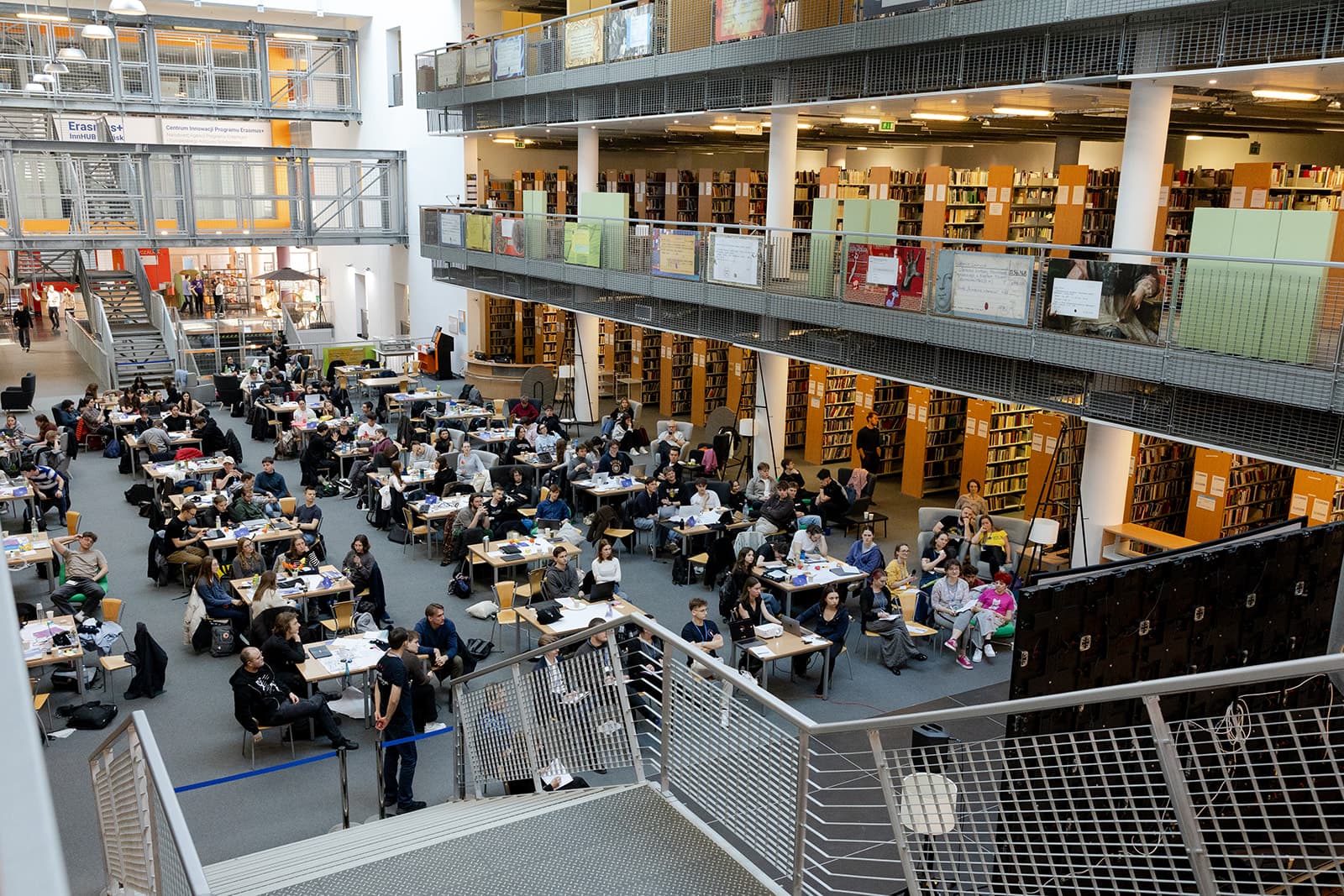
March 2026, Gdańsk. The University of Gdańsk library, 150 students, a hackathon for NGOs. And for the third time in a row — I wanted to participate, but only students could. Applied as a mentor. The pattern was so obvious at this point that I started laughing at it.
This event was different from previous ones. Students have a completely different energy than the experienced people at Critical Infrastructure. They came up to me with questions on their own, soaked up knowledge, were open to change. The tasks were close to their hearts — social issues, local challenges. How to make locality more attractive than big investments on the coast. These weren't abstract corporate tasks. People actually cared.
And then came the surprise. An hour before the start, the organizers say "get on stage and spend two minutes telling people about yourself and how you can help". In front of 150 people. I would never have done this on my own. But I went up, said my piece, and suddenly people knew who to find with questions. Instant recognition. And it turned out it's really not that scary.
The vibe was super relaxed. After commercial hackathons, this was a breath of fresh air. I slept on a chair in the library, people slept in the aisles between bookshelves. More than half the participants stayed up all night. The organizers were genuinely happy I'd found them on my own and wanted to help. If I had to recommend someone's first hackathon for mentoring — it would be exactly this kind of event. Students have different needs than people building products. Less pressure, faster results, more open people. The best entry point you can get.
What I took away from those six months
There's a pattern that repeated at every single event. Stress at the beginning, then you realize you can handle it, then confidence grows. But the source of stress evolves. At HackNation: "can I do this at all?". At Critical Infrastructure: "can I keep up with these people?". At Idea2Impact: "I have to get on stage?!". Stress doesn't disappear — it changes shape. And that's fine.
The second recurring theme: Plan B always turned out better than Plan A. Every time I wanted to be a participant. Every time it didn't work out. Every time mentoring gave me more — more connections, more learning, more pushing of my own boundaries. A paradox that couldn't be a paradox anymore.
And probably the most important thing: you don't need to be an expert to help. You just need a bit more experience than the participants. Knowledge from observing, from being around it — from osmosis — is real and valuable. I never made pitch decks, but I'd seen hundreds. And that was enough.
In six months I went from stressing over a beer at a meetup to standing on stage in front of 150 people. Not because I'm exceptionally brave. Because each step pushed the comfort zone a little further. And every time, that boundary turned out to be more in my head than in reality.
always turned out better
What's next
I'm planning to organize a hackathon-workshop hybrid for NGOs in the Tricity area later this year. Intimate, 30–40 people, knowledge transfer both ways. Networking from events is coming back as the foundation — contacts from Gdańsk are a direct result of mentoring there. Full circle: from a meetup over beers, through participating, through mentoring, to organizing my own event.
And if someone's reading this thinking "I couldn't do it" — I thought the same. I still think that before every event. The difference is that now I know that feeling goes away after the first conversation with participants. Cost: your time and a bit of stress. The payoff — massive. The limit is in your head. The first time won't be your best. But without that step, there's no growth.